Senior engineers doing mechanical work
Writing, formatting and cross-referencing hundreds of artefacts is the most expensive time on the programme, spent on the least valuable task.
AI-enhanced MBSE
ASYST reads a project brief and produces the system model behind it: ISO 29148 requirements, functional and physical architecture, a scored risk register, a V&V matrix and an end-to-end traceability chain. Hours, not weeks.

The problem
Writing, formatting and cross-referencing hundreds of artefacts is the most expensive time on the programme, spent on the least valuable task.
A misread requirement or an unverified constraint travels through the whole model and costs orders of magnitude more to fix later.
Cameo, Capella and DOORS are strong repositories. They hold what engineers create. The bottleneck was never the repository.
That is backwards. The engineers deserve a tool that works for them.
Brief in, a complete system model out. ASYST reads what you give it, extracts the system context, then builds forward: each artefact derived from the one before it, every link recorded, every gap flagged rather than quietly inherited. What comes back is not an outline. It is nine artefacts that reference each other, ready for an engineer to review and own.
A project brief, a statement of work, or a concept description. Written or uploaded.
Nine stages, each validated before the next begins, each artefact linked to the last.
Every artefact is browsable and traceable. Export the Need Analysis document when it is right.
Stakeholders, constraints, operating environment and the performance drivers that actually bound the design, pulled out of the brief before anything is written.
The system broken into subsystems with defined boundaries, so every downstream artefact has something concrete to be allocated to.
Written to ISO 29148 and IEEE 830: atomic, uniquely identified, verifiable, and without the ambiguity that gets caught at review and reworked afterwards.
The functions the system must perform, allocated to the subsystems that carry them, with the load per subsystem visible rather than assumed.
Risks drawn from the requirements and the concept, scored by likelihood and consequence, and rolled up to the subsystems they actually land on.
A verification method and an acceptance criterion for every requirement, so nothing reaches test without a defined way to pass it.
Components, the functions allocated to each of them, and the interfaces between them defined rather than left to be discovered at integration.
Every requirement traced through to the functions, components, risks and verification entries derived from it. Both directions, end to end.
The whole model assembled into a document you can take into a gate review, export, and put on the programme record.
What nothing else does
Edit a requirement and ASYST propagates the impact across functions, components, risks and V&V entries. Gaps are flagged, not silently inherited. The model stays internally consistent without anyone maintaining it by hand.
How the agent works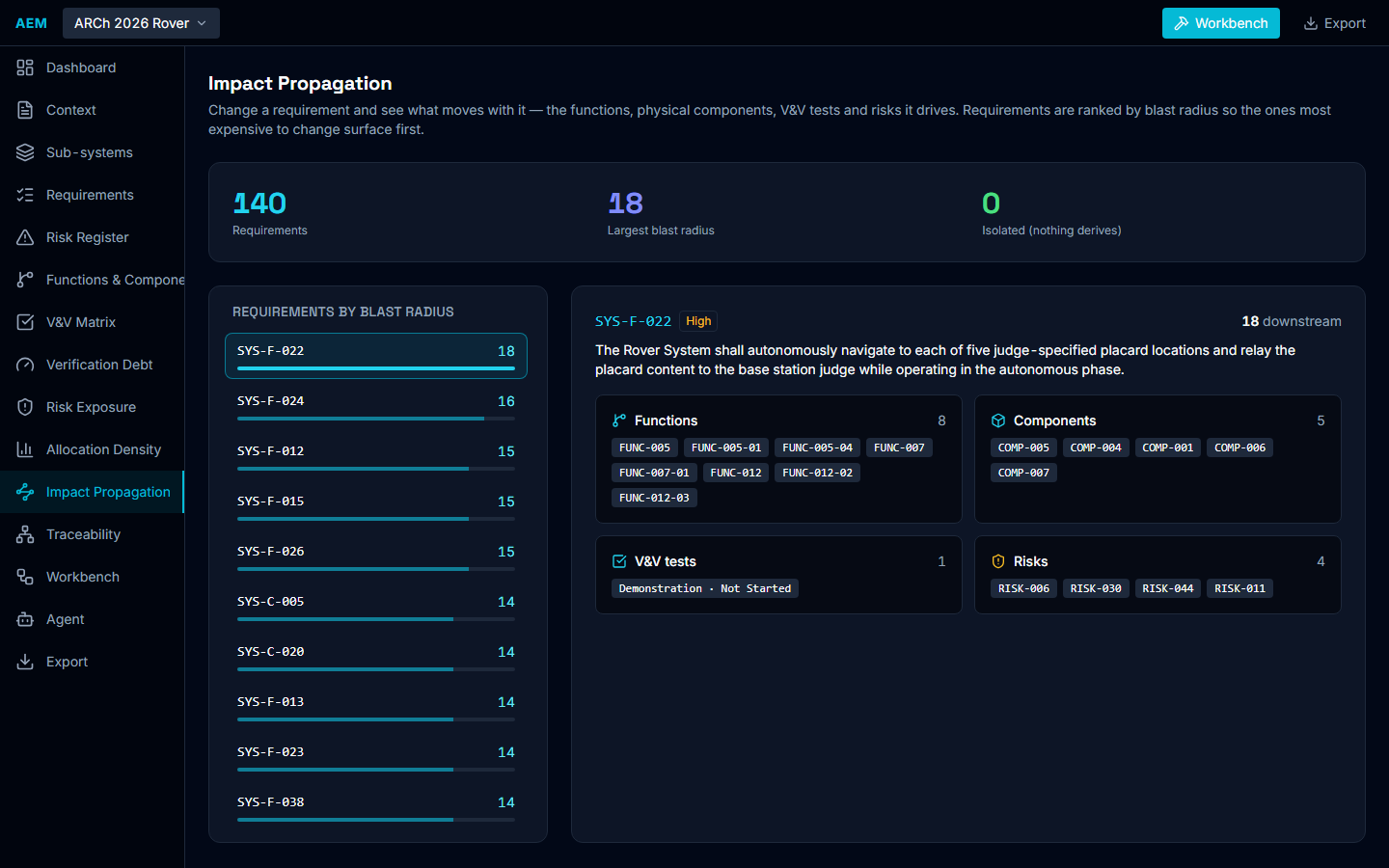
Gate reviews and bid dates do not move. Model production is the part of the programme that always runs late, and the part nobody can shorten by adding people.
Fixed-price systems engineering work is won on scope and lost on artefact production. Generate the baseline, then charge for the judgement applied to it.
A small team carrying every programme in the business. ASYST gives each engineer the artefact output of a team, still under that engineer's review and sign-off.
You need a defensible model before there is a budget to build one. Stand one up in an afternoon and take it into the review with the traceability already in place.
ASYST does not replace the engineer. It removes the mechanical work so senior engineers spend their time on decisions, trade-offs and stakeholder engagement, which is where their value actually is. What comes out is more defensible, because every link is explicit and every gap is flagged rather than quietly inherited.
The tiers below take effect at general availability. Nothing is metered today, so you can run a full programme model through the pipeline and decide on the evidence. Prices in AUD, excluding GST.
A$0
One active project, the full nine-stage pipeline and every artefact view. Document export is the wall.
A$199 / month
Ten active projects, Need Analysis export as DOCX and PDF, impact propagation and version history.
Contact
Unlimited projects, SSO, private or on-premises deployment and priority support.
Paste a brief in directly, or upload a project brief, statement of work, tender response or concept description. ASYST works from prose, so anything a systems engineer could sensibly start a model from is a valid input.
No. Cameo, Capella and DOORS are repositories, and they are good ones. ASYST does the generation they were never built to do, and gives you the artefacts and the traceability chain to take wherever your programme keeps its record.
You do. The brief you upload and every artefact generated from it stay yours. STREaMLiNE claims no rights over your project content or the model built from it.
Yes. ASYST generates a complete, internally consistent model. A competent systems engineer reviews and owns it, exactly as they would review a junior engineer's work.
One system model: the brief you upload, the nine stages of artefacts generated from it, and the traceability chain linking them. The project is the unit pricing is metered on once ASYST leaves early access.
With your Microsoft, Google or GitHub account. There is no separate password to manage.
Free to start. One project, the full pipeline, every artefact.
Start free