AI-enhanced MBSE

Your engineers are writing requirements, not engineering.

ASYST reads a project brief and produces the traceable system model behind it: ISO 29148 requirements, architecture, risks and V&V. Hours, not weeks.

Your engineers are working for the tool.

They feed it, format it and cross-reference it, instead of deciding what the system should be.

  • Senior engineers on clerical work

    The most expensive hours on the programme, spent formatting.

  • Early errors propagate silently

    Found late, they cost orders of magnitude more to fix.

  • Your tools store, they do not generate

    Cameo, Capella and DOORS hold what engineers write. The bottleneck was never the repository.

Today · Artefacts kept in step by hand

The problem: artefacts kept in step by handA brief is retyped by hand into four separate files: a requirements specification, a risk sheet, a V and V matrix and an interface control document. The only links between them are manual copies. REQ-014 has changed in the specification, and the V and V matrix still cites the old version: a broken link nobody is told about. BRIEF the input REQ SPEC REQ-014 v2 RISK SHEET separate file V&V MATRIX cites REQ-014 v1 ICD separate file retyped by hand copied separate files · every link kept by a person

That is backwards. Brief in, traceable model out.

Nine checked stages turn your brief into a model an engineer reviews and owns.

  1. 01

    Upload the brief

    A brief, a statement of work or a concept.

  2. 02

    The pipeline runs

    Nine stages, each validated before the next.

  3. 03

    Review and export

    Every artefact traceable, then exported.

See every stage

ASYST · The pipeline

The ASYST pipeline: brief in, traceable model outThe brief feeds nine stages run in order: 01 context, 02 subsystems, an approval gate, 03 requirements, 04 functions, 05 risks, 06 V and V, 07 components, 08 traceability and 09 the Need Analysis, exported as DOCX or PDF. Each stage reads what the ones before it produced. BRIEF 01 Context 02 Subsystems 03 Requirements 04 Functions 05 Risks 06 V&V 07 Components 08 Traceability 09 Need Analysis approval gate DOCX · PDF each stage checked before the next

Change one requirement. The model changes with it.

Edit a requirement and ASYST flags every artefact derived from it.

  • Typed edges make the chain queryable.
  • Traceability is computed, never hand-written.
How the output holds up

Model · Impact propagation

Impact propagation from one edited requirementREQ-014, timestamp accuracy, is edited. Five downstream artefacts are flagged as affected, each through a typed edge: FUNC-021, acquire time reference, and FUNC-022, stamp the record, both satisfied by; COMP-007, onboard computing, allocated to; VV-014, drift test of 45 minutes, verified by; and RISK-009, clock drift on patrol, which it drives. REQ-014 edited FUNC-021 Acquire time reference satisfied by FUNC-022 Stamp the record satisfied by COMP-007 Onboard computing allocated to VV-014 Drift test, 45 min verified by RISK-009 Clock drift on patrol drives

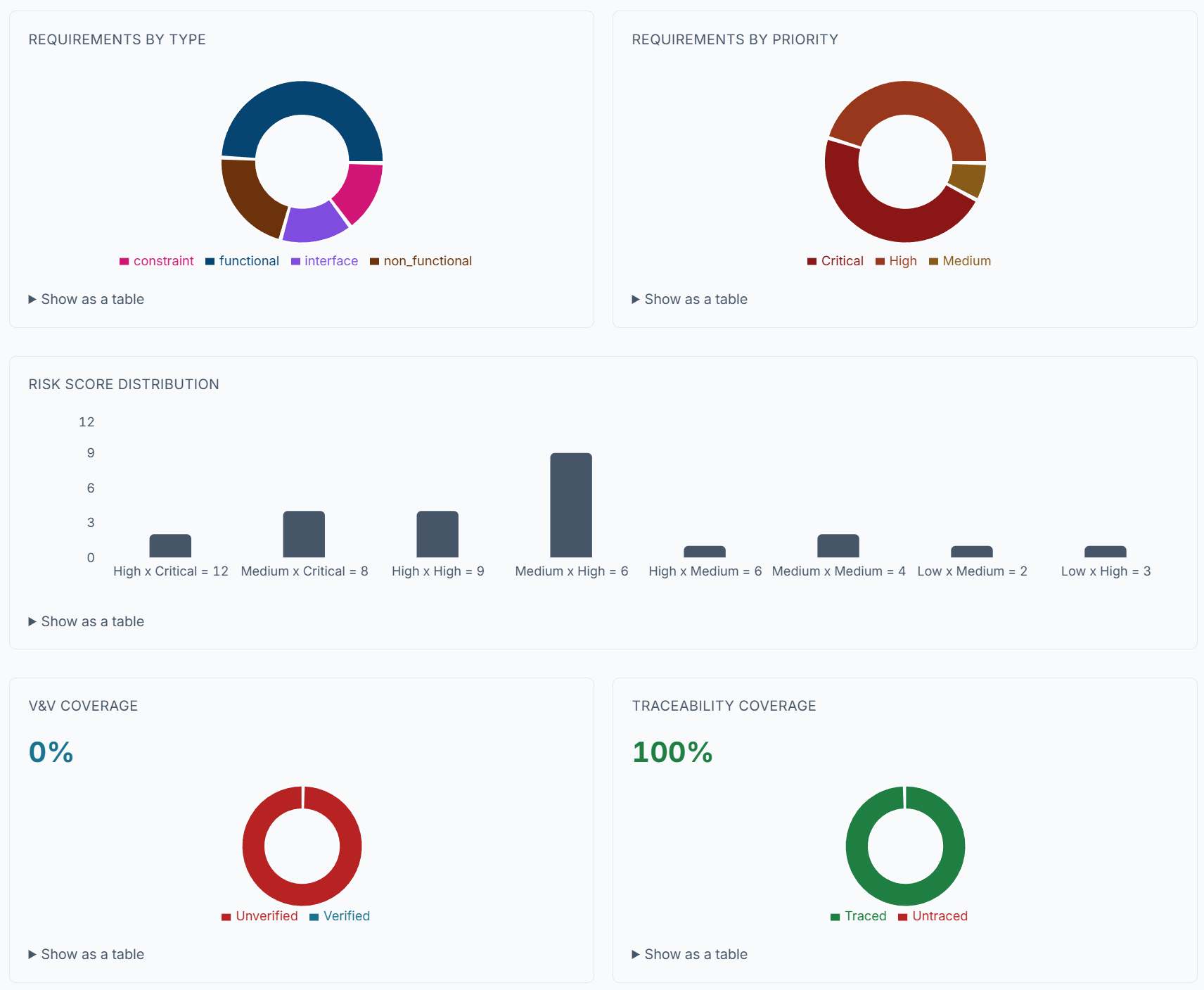
Nine artefacts from one brief, gaps included.

Every capture here is one real project, generated by ASYST and live now.

  • ISO 29148 requirements, atomic and verifiable
  • Functional and physical architecture, interfaces defined
  • A scored risk register, attributed per subsystem
  • A V&V matrix, incomplete rows counted
  • Traceability computed end to end
Open the live project
An ASYST project dashboard showing five panels: requirements by type, requirements by priority, a risk score distribution with eight likelihood-by-consequence bars, and two coverage dials reading V and V coverage 0 per cent in red and traceability coverage 100 per cent in green.
Mid-flight: traceability 100%, V&V honestly 0% because that stage has not run.

Start with the brief you have open right now.

Free to start. One project, the full pipeline, every artefact.

Start free
Next 01The Workflow

All nine stages in order, from the brief to the Need Analysis document.